2019年6月25日星期二

DESCRIPTION. ME603--联系13922125860

PRODUCT DESCRIPTION. ME603 is part of the DuPont suite of materials developed for In. Mold Electronic applications. ME603 is a stretchable silver conductor 

PRODUCT DESCRIPTION ME603 is part of the  suite of materials developed for In Mold Electronic applications. ME603 is a stretchable silver conductor capable of withstanding thermoforming and overmolding temperatures. This composition can be used for Capacitive Switch applications and interconnecting circuitry enabling fully integrated 3-dimensional functional electronic devices.
PRODUCT BENEFITS • Higher conductivity silver for In Mold Electronics • Minimal/no silver show-through on graphics layer • Excellent adhesion directly on polycarbonate and graphic inks • Excellent performance after thermoforming and injection molding
PROCESSING CONDITIONS Substrates Polycarbonate
Screen Printing Equipment Reel-to-reel, semi-automatic or manual
Ink Residence Time on Screen >1 Hour
Screen Types Polyester, stainless steel

广州市银标贸易有限公司
Guang Zhou City Silver Well trading Co.,ltd.‍
广州市番禺区钟村镇钟荣路1号致业科技中心A栋3楼AS388
电 话:020-23830796   23830403
传 真:020-34637699

赖强平: 13922125860    QQ: 598362644

2019年6月24日星期一

PTC自控温碳浆

自控温碳浆
TECHNICAL DATA SHEET
(CI-3061PL CI-3062PH)
CI-3061PL CI-3062PH Carbon Conductor
(Polymer Thick Film Composition)
PRODUCT DEION
Carbon conductor CI-3061PL & 3062PH is used to fabricate low voltage circuitry, especially on flexible substrates. CI - 3061PL & 3062PH is a general purpose polymer
thick film carbon containing conductor for use on print-treated and non print-treated
polyester. Using a unique combination of carbon, graphite and resin technology, CI-3 061PL& 3062PH possesses a good positive temperature coefficient(PTC) effect, and
printability. It can be used with semi-automatic, and manual printers, and offers excellent
residence time on the screen. PROCESSING
- Screen Printing Equipment
: Semi-automatic, manual - Substrates
: Polyester, Polycarbonate etc... - Ink Residence Time on Screen
: > 1 hour

- Screen Type
: Polyester, Stanless steel, etc... - Typical Dry Conditions
: 150℃ for 10 min in convection oven
- Typical Circuit Line Thickness Printed with :
: 6~8 ? with 250mesh
- Clean up Solvent
: MEK, n-Cyclohexanon
STORAGE AND SHELF LIFE
NHEM thick film polymeric compositions should be stored at ambient temperatures. The shelf life of material in unopened containers is a minimum of 1 year. Some settling
of solids may occur, so compositions should be stirred thoroughly prior to use.
Table 1. Typical Properties on Polyester Film
CI-3061PL
(Low Resistivity)
CI-3062PH
(High Resistivity) Remarks
Volume Resistivity(Ω/sq/cm) < 0.35 > 10
Viscosity(Poise)*
(B.F.Viscometer, #14, 25℃)
Adhesion/Tape Pull
(3M Scotch Tape #600)
Pencil Hardness
Hardness(ASTM D3363-74) * Viscosity can be increase during storage.
280 ~ 380 280 ~ 380
100/100 100/100
> 1H > 1H
Table 2. Typical PTC Property** PTC property
(ref. 25℃)
50℃ 60 %
70℃ 150 %
90℃ 250 %
110℃ 300 %
Thermal Resistivity (120℃/2hr) < ± 10%
On-Off test
12Volt On-Off, interval 15min, 100times < ± 15%
100Volt On-Off, interval 15min, 100times < ± 15%
** 3016PL: 3062PH= 30 : 70 mixed with weight %
SAFETY AND HANDLING
This product contains organic solvent and materials. The following precautions should
be exercised when handling CI-3061PL&3062PH. - Use with adequate ventilation
- Avoid prolonged contact with skin. If contact with skin occurs, wash affected area
immediately with soap and water. - Avoid prolonged breathing of vapor
广州市银标贸易有限公司
Guang Zhou City Silver Well trading Co.,ltd.‍
广州市番禺区钟村镇钟荣路1号致业科技中心A栋3楼AS388
电 话:020-23830796   23830403
传 真:020-34637699

赖强平: 13922125860    QQ: 598362644

IMD/IME模内注塑,可穿戴产品专用可拉伸导电银浆CI-1036

IMD/IME模内注塑,可穿戴产品专用可拉伸导电银浆CI-1036 
广州市银标公司供应:IMD/IME模内注塑,可穿戴产品专用可拉伸导电银浆,原厂质量保证,欢迎咨询洽谈。

广州市银标贸易有限公司
Guang Zhou City Silver Well trading Co.,ltd.‍
广州市番禺区钟村镇钟荣路1号致业科技中心A栋3楼AS388
电 话:020-23830796   23830403
传 真:020-34637699

赖R: 13922125860    QQ: 598362644

CI-1036 is silver conductive ink designed for superior durability and crease 
resistance along with low resistance and long screen residence time. The main 
uses of CI-1036 are for switches that are subject to deformation e.g. poly-doming 
or intentional creasing or flexing e.g. tail fold-over. CI-1036 shows excellent 
adhesion to print treated polyester. 

ADVANTAGES ? Excellent abrasion resistance
? Extended screen residence
? Extremely flexible
? Highly conductive
TYPICAL 
UNCURED 
PROPERTIES
Color
Viscosity
Total Solids Content
Density
Flash Point
VOC
Silver
12,000 CPS 25°C #51 5 rpm
69%
18.2 lbs/gallon (2.18 kg/l)
230oF (110
oC) Tag Closed Cup
674.8 grams of solvent/liter
TYPICAL CURED 
PROPERTIES
Electrical Resistance
Theoretical Coverage
< 0.010 ohms/square @ 1.0 mil
< 0.010 ohms/square @ 25.4 microns
Cured 10 Minutes at 248°F (120°C)
531.3 ft2
/Gal/Mil
5.99 m2
/kilogram/25.4 microns

2018年9月27日星期四

What are Force Sensing Resistors? Force Sensing Resistors (FSR) A Force Sensing Resistor (FSR) is a printed functional ink applied to a thin material whose resistance changes when a force is applied to it. The force can be a mechanical load, a pressure or physical action. Force Sensing Resistor can also be known as a “force-sensitive resistor”. FSR is a variable resistor, constructed of several thin flexible layers and conductive inks that are applied using a precision screen printing process. These layers vary in resistance as pressure is applied and released. As pressure is applied, the resistance lowers and then returns to its original value as the pressure is removed. An FSR’s main purpose is to measure the force applied to a specific area and then relay that information via selected output electronics. FSRs typically use high-resistance, carbon-based inks which, along with other design factors, can be re-formulated to alter the functionality. Force Sensing Resistors can be designed as single-zone FSRs, Matrix Arrays, Discrete Arrays, Resistive XYZ (Digitizer) Pads, and Linear Potentiometers. Single-Zone ShuntMode™ and ThruMode™ FSRs There are two basic FSR configurations: the ShuntMode™ and the ThruMode™. ShuntMode Force Sensing Resistor: Consist of printed silver inter-digitated fingers that are shorted (“shunted”) by a printed FSR carbon layer. Can detect a wider range of forces with a more linear output. Are generally less costly due to fewer print steps and reduced ink usage. ThruMode Force Sensing Resistor: Are more receptive to lighter forces Not limited to the same print constraints as the ShuntMode’s interdigitated silver fingers, thus allowing for smaller form factors Require more silver and carbon ink, thus making them more costly. Among the many applications, some of the common Force Sensing Resistor uses include: Up/Down and Force/Speed Controls Musical Instrument Controllers Infusion Pumps Podiatry Foot Gate Analysis Motor / Tool Speed Control Robotic Finger Tips Seat / Bed Occupancy Detection Inventory Control

What are Force Sensing Resistors?

Force Sensing Resistors (FSR)

A Force Sensing Resistor (FSR)  is a printed functional ink applied to a thin material whose resistance changes when a force is applied to it.  The force can be a mechanical load, a pressure or physical action.  Force Sensing Resistor can also be known as a “force-sensitive resistor”.  FSR is a variable resistor, constructed of several thin flexible layers and conductive inks that are applied using a precision screen printing process.  These layers vary in resistance as pressure is applied and released. As pressure is applied, the resistance lowers and then returns to its original value as the pressure is removed. An FSR’s main purpose is to measure the force applied to a specific area and then relay that information via selected output electronics.  FSRs typically use high-resistance, carbon-based inks which, along with other design factors, can be re-formulated to alter the functionality.  Force Sensing Resistors can be designed as single-zone FSRs, Matrix Arrays, Discrete Arrays, Resistive XYZ (Digitizer) Pads, and Linear Potentiometers.

Single-Zone ShuntMode™ and ThruMode™ FSRs

There are two basic FSR configurations: the ShuntMode™ and the ThruMode™.

ShuntMode Force Sensing Resistor:

Consist of printed silver inter-digitated fingers that are shorted (“shunted”) by a printed FSR carbon layer.
Can detect a wider range of forces with a more linear output.
Are generally less costly due to fewer print steps and reduced ink usage.
ThruMode Force Sensing Resistor:

Are more receptive to lighter forces
Not limited to the same print constraints as the ShuntMode’s interdigitated silver fingers, thus allowing for smaller form factors
Require more silver and carbon ink, thus making them more costly.
Among the many applications, some of the common Force Sensing Resistor uses include:

Up/Down and Force/Speed Controls
Musical Instrument Controllers
Infusion Pumps
Podiatry Foot Gate Analysis
Motor / Tool Speed Control
Robotic Finger Tips
Seat / Bed Occupancy Detection
Inventory Control


Force Sensing Resistors (FSR)

A Force Sensing Resistor (FSR)  is a printed functional ink applied to a thin material whose resistance changes when a force is applied to it.  The force can be a mechanical load, a pressure or physical action.  Force Sensing Resistor can also be known as a “force-sensitive resistor”.  FSR is a variable resistor, constructed of several thin flexible layers and conductive inks that are applied using a precision screen printing process.  These layers vary in resistance as pressure is applied and released. As pressure is applied, the resistance lowers and then returns to its original value as the pressure is removed. An FSR’s main purpose is to measure the force applied to a specific area and then relay that information via selected output electronics.  FSRs typically use high-resistance, carbon-based inks which, along with other design factors, can be re-formulated to alter the functionality.  Force Sensing Resistors can be designed as single-zone FSRs, Matrix Arrays, Discrete Arrays, Resistive XYZ (Digitizer) Pads, and Linear Potentiometers.

Single-Zone ShuntMode™ and ThruMode™ FSRs

There are two basic FSR configurations: the ShuntMode™ and the ThruMode™.

ShuntMode Force Sensing Resistor:

Consist of printed silver inter-digitated fingers that are shorted (“shunted”) by a printed FSR carbon layer.
Can detect a wider range of forces with a more linear output.
Are generally less costly due to fewer print steps and reduced ink usage.
ThruMode Force Sensing Resistor:

Are more receptive to lighter forces
Not limited to the same print constraints as the ShuntMode’s interdigitated silver fingers, thus allowing for smaller form factors
Require more silver and carbon ink, thus making them more costly.
Among the many applications, some of the common Force Sensing Resistor uses include:

Up/Down and Force/Speed Controls
Musical Instrument Controllers
Infusion Pumps
Podiatry Foot Gate Analysis
Motor / Tool Speed Control
Robotic Finger Tips
Seat / Bed Occupancy Detection
Inventory Control

What are Force Sensing Resistors?什么是力感应电阻?

What are Force Sensing Resistors?

Force Sensing Resistors (FSR)

A Force Sensing Resistor (FSR)  is a printed functional ink applied to a thin material whose resistance changes when a force is applied to it.  The force can be a mechanical load, a pressure or physical action.  Force Sensing Resistor can also be known as a “force-sensitive resistor”.  FSR is a variable resistor, constructed of several thin flexible layers and conductive inks that are applied using a precision screen printing process.  These layers vary in resistance as pressure is applied and released. As pressure is applied, the resistance lowers and then returns to its original value as the pressure is removed. An FSR’s main purpose is to measure the force applied to a specific area and then relay that information via selected output electronics.  FSRs typically use high-resistance, carbon-based inks which, along with other design factors, can be re-formulated to alter the functionality.  Force Sensing Resistors can be designed as single-zone FSRs, Matrix Arrays, Discrete Arrays, Resistive XYZ (Digitizer) Pads, and Linear Potentiometers.

Single-Zone ShuntMode™ and ThruMode™ FSRs

There are two basic FSR configurations: the ShuntMode™ and the ThruMode™.

ShuntMode Force Sensing Resistor:

Consist of printed silver inter-digitated fingers that are shorted (“shunted”) by a printed FSR carbon layer.
Can detect a wider range of forces with a more linear output.
Are generally less costly due to fewer print steps and reduced ink usage.
ThruMode Force Sensing Resistor:

Are more receptive to lighter forces
Not limited to the same print constraints as the ShuntMode’s interdigitated silver fingers, thus allowing for smaller form factors
Require more silver and carbon ink, thus making them more costly.
Among the many applications, some of the common Force Sensing Resistor uses include:

Up/Down and Force/Speed Controls
Musical Instrument Controllers
Infusion Pumps
Podiatry Foot Gate Analysis
Motor / Tool Speed Control
Robotic Finger Tips
Seat / Bed Occupancy Detection
Inventory Control

什么是力感应电阻?

力感应电阻器(FSR)

力感应电阻器(FSR)是一种印刷的功能性墨水,应用于薄材料,当施加力时,其电阻会发生变化。力可以是机械载荷,压力或物理作用。力感应电阻也可称为“力敏电阻”。 FSR是一种可变电阻器,由几个薄的柔性层和导电油墨构成,使用精密丝网印刷工艺进行涂覆。当施加和释放压力时,这些层的电阻变化。当施加压力时,电阻降低,然后在压力消除后恢复到其原始值。 FSR的主要目的是测量施加到特定区域的力,然后通过选定的输出电子设备传递该信息。 FSR通常使用高阻碳基油墨,与其他设计因素一起,可以重新配制以改变功能。力感应电阻器可以设计为单区FSR,矩阵阵列,离散阵列,电阻XYZ(数字化仪)焊盘和线性电位计。

单区ShuntMode™和ThruMode™FSR

有两种基本的FSR配置:ShuntMode™和ThruMode™。

ShuntMode力感应电阻器:

由印刷的银色交叉指状物组成,通过印刷的FSR碳层短路(“分流”)。
可以通过更线性的输出检测更宽范围的力。
由于较少的印刷步骤和减少的油墨用量,通常成本较低。
ThruMode力感应电阻器:

更容易接受更轻的力量
不限于与ShuntMode的叉指银指相同的打印限制,因此允许更小的形状因子
需要更多的银和碳墨水,从而使它们更昂贵。
在众多应用中,一些常见的力传感电阻器用途包括:

上/下和强制/速度控制
乐器控制器
输液泵
足病学足门分析
电机/工具速度控制
机器人手指提示
座椅/床占用检测
库存控制


2018年7月26日星期四

Stretchable Electronics Inks(可伸缩性导电油墨)

Stretchable Electronics Inks
gzyinbao has combined Printed Electronics and textile printing to offer new conductive and protective inks for printing stretchable electronics on fabricInks

gzyinbao provides an assorted range of materials for “Stretchable Electronics” applications, such as:

Silver Based (micrometric flakes) Conductive Inks
Protective/Encapsulating Inks
Adhesive inks for Transfer Printing
All the Inks are:

Water-based
Screen printable
Highly stretchable (tested up to 100% of elongation)
Protective/ encapsulating inks are used in synergy with conductive inks. Their functions are:

Structural support/mechanical stress absorption
Barrier to water (for washing resistance)
Electrical insulation
Printing Technology


 elastic (TPU) membranes are used as printing substrate to be further laminated on the final product surface:

In case of textile applications (smart-garments, wearable technology type of applications) the transfer printing technology is used to transfer, by heat and pressure, the ink layer set from a sacrificial substrate to the final fabric
In case of other applications the printed stack of inks can be peeled-off from the sacrificial substrate for further handling
The transfer printing process is explained in the picture below.

Figure 1. – Process in the case of final application on fabric


Ink layers and a thermoplastic glue are screen printed on a sacrificial substrate
The ink layer set is transferred, using a heat press, by activating the thermoplastic glue (current parameters are: 180°C/4 bar/15 sec)
The sacrificial substrate is peeled-off
Final curing is performed (5 min at 150°C for best performances)
The adopted technology has a few advantages:

Reliable printing on a smooth and stable (sacrificial) substrate
Full additive and simpler process. No membrane laser cutting-out is required as the printing substrate is totally removed after the transfer of the ink stack onto the final substrate
Better “look and feel” and comfort. No permanent intermediate substrate is left on the fabric.
Electrical performances under strain


There is no standard to evaluate stretchable conductive Inks. We test our inks with single elongations, up to 100%, and repeated cycles (typically 1000) of 0-20% elongations.

Initial sheet resistivity is <30 mOhm/square@25micron (after curing of the ink at 150°C for 5min). The below graphs show the typical resistance behavior under strain.

Figure 2. – Single stretch


The above performances relate to a straight line conductive trace 150mm long/4mm wide

According to our experience many factors affect performances under strain:

Ink silver flakes characteristics, concentration and mix
Protective inks. Protective inks more resistant to washing exhibit a lower elasticity. This affects the overall electrical performance, especially under repeated strains
Final fabric, in particular the weave more than the raw material
Trace shape. Straight lines and corners are not the best performer
gzyinbao has developed base conductive inks and a few protective inks which can be customized for the specific application.

Please contact us ( laiqiangping2015@gmail.com) to evaluate ink performances against your requirements

The offering


Stretchable electronics, offerta

gzyinbao can provide either the inks or the printed layer set ready to be transferred to the final fabric. The second option is recommended for initial tests or quick feasibility studies.


gzyinbao can provide direct assistance to Clients in the fine tuning of the printing processes, in the assessment of performances and in the evaluation of possible ink customizations.
E-mail: laiqiangping2010@163.com   laiqiangping2015@gmail.com

2018年7月25日星期三

Applications and Material Sets for Printed Electronics(广州银标供应先进:功能性导电油墨)

Applications and Material Sets for Printed Electronics

Stretchable Inks

New products for new applications

For applications where the already good flexibility  materials is not sufficient a new, stretchable, line of siloxane polymer materials has been developed. They are targeted especially at emerging technology areas like smart textiles and 3D embossed structures.


Inks Medical
 Ag/AgCl inks, are used extensively in
Medical sensors
 Typical uses
 Tens/EKG pads
 Glucose sensors
 Blood thinner sensors
 These sensor inks record the current or
“potential” generated by the reactions of
different substances
 From this the concentration of the
targeted substance can be calculated


Inks Sensors
 PTC ink (Positive
temperature coefficient)
 As these inks get hotter they
also get higher in resistance.
This allows them to regulate
the current supplied to them.
 FSR inks (Force sense
resistor)
 As pressure is applied these
ink become more conductive.

Inks Medical (Iontophoresis)
 With printed Ag/AgCl electrode, a
small current is applied to activate
human’s skin and ionize drug
molecules, enhancing the delivery
of drug or nutrition.
 Increasing current can increase
delivery rate


In-Mold Decorating

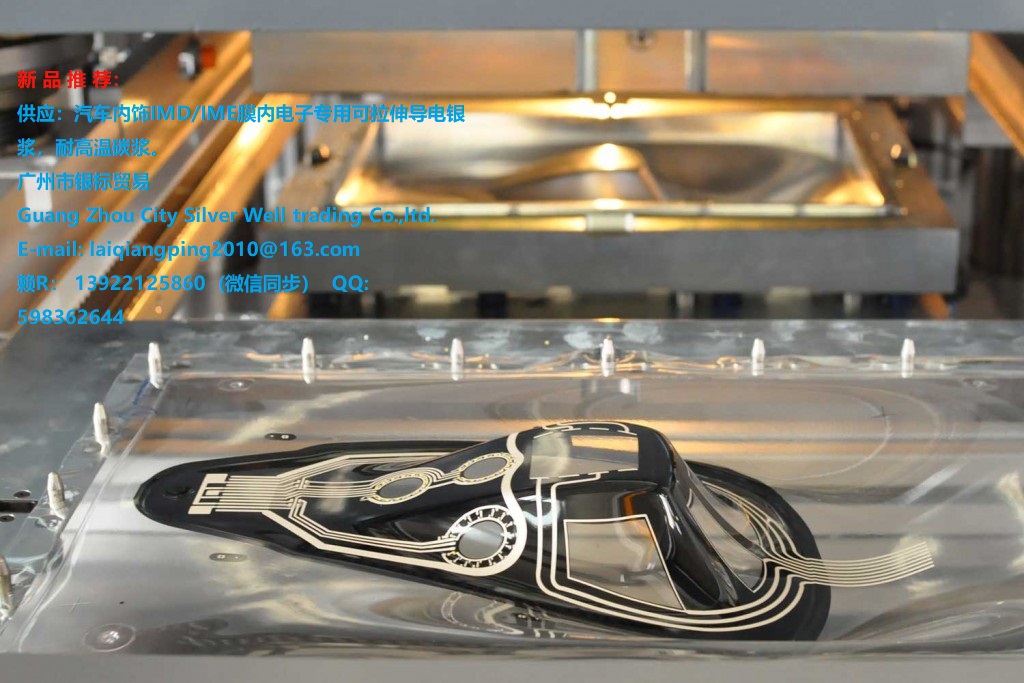
 we offer revolutionary inks, proprietary hardcoated films and other substrates that are rapidly expanding the possibilities for In-Mold Decorating (IMD) and In-Mold Labeling (IML), making the manufacture of In-Mold Electronic (IME) parts a reality for the first time.


In-Mold – Where Form Meets Function
When specifying for an in-mold project, the materials selected make all the difference for the end product. Ensuring you start with the best and most compatible inks, films, resins and knowledgeable supply partners are crucial to production success.

With  materials, outstanding durable graphics are possible despite the films and inks being exposed to the extreme heat of forming, injection of molding resins, and the forces of extensibility. So stretch and form; put Tekra materials to the test and discover:

Production reliability
Superior bonding
Exceptional ink adhesion and stability against cracking
Outstanding yields
Our reputation for delivering on successful outcomes starts with an extensive choice of SABIC Innovative Plastics specifically formulated for in-mold decorating. We offer a broad range of film styles and types in a myriad of textures, finishes, colors and effects.

When the application demands it, Tekra, a pioneer in coating development for IMD, applies a proprietary hardcoat to the film. Tekra has a full line of versatile coatings that allow different textures with outstanding resistance to chemicals and abrasion that are designed for in-mold processing.


gzyinbiao offers superior conductive inks and conductive coatings to address a wide variety of applications in the energy, consumer electronics and utilities industries. dielectric inks product range of conductive, dielectric and other functional,In Mold Electronics (IME) polymer thick film inks have been used to apply selective coatings on a variety of flexible and rigid substrates, via screen, flexographic and rotogravure printing methods.

Our conductive coatings and inks can be effectively dried or cured through heat or UV radiation.  conductive inks (silver, silver/silverchloride, carbon-based, dielectric and other functional [e.g., electroluminescent pigments-based]) are used for the production of:

Flexible circuits for membrane touch switches
Keyboards for desktop and notebook PCs
Heating elements
Automotive sensors
Biosensors and EKG/ECG electrodes
Antennas for contactless smart cards and RFID labels
Touch screens
EL lamps
Printed circuit boards and potentiometers

1. Application: apply to cell phones, computers and electronic information, communication equipment, precision equipment and so on..

2. Features:
1) has excellent electromagnetic shielding effect; 
2) ABS, PC, ABS / PC, PA, HIPS plastic substrate, such as excellent adhesion 
3) 100% pure silver powder medium, conductive properties of a good 
4) excellent resistance to abrasion 
5) the humidity of the fine 
6) drying of the fine 
7) The film-forming properties, and no powder from the phenomenon of hard durable paint film 
8) The product is not easy layered sediment, and strong operating .


In-Mold Electronics is the combination of traditional In-Mold Decorating (IMD) technology with Printed Electronics. The result is an aesthetically pleasing, highly-functional, lightweight, and lower-cost alternative to traditional Human Machine Interfaces (HMI) with mechanical switches.


In-Mold electronics is gaining popularity in the Automotive, Medical Device, and White Goods markets for creation of Smart Surfaces within their products. In the near future, other markets will adopt this technology as the advantages and consumer interests are recognized.

Typically, an In-Mold Electronics application starts with the sub-surface screen printing of multiple layers of decorative, conductive, and dielectric inks on sheets of polycarbonate or polyester film. After curing, the printed films are thermo-formed to a 3D shape and die-cut free of the sheet. The imaged thin 3D forms are placed in an injection mold to have clear or colored resin injected behind it. The resulting part is a rigid plastic component with functionality. Surface mount components such as LEDs and connectors can be added prior to or after the forming and molding operations to increase functionality.

广州市银标贸易有限公司
联系人:赖先生
手机:13922125860
固话:+86-20-23830796 23830403
传真:+86-20-34637699
网址:www.gzyinbiao.com
邮箱:laiqiangping2010@163.com
地址:广州市番禺区钟村镇钟荣路1号